Annual Reports
PayPal Holdings, Inc.'s annual reports contain management's most considered account of the business. These are the sections, passages and visual pages worth opening in the originals preserved in Sources.
PayPal Holdings, Inc. — FY2025 Annual Report (Form 10-K) — FY2025 (year ended Dec 31, 2025)
The latest 10-K, and the one that documents PayPal's shift from volume-at-any-cost to profitable growth — transactions actually fell while margin rose. · Open the full document →
Item 1. Business — Overview — p. 5 · Read the full section →
The cleanest statement of what PayPal is: a two-sided network of 439M accounts that earns fees on transaction volume, plus a ladder of value-added revenue.
The two-sided network and how it earns money — volume fees first, value-added services second.
We operate a global, two-sided network at scale that connects consumers and merchants with 439 million active accounts across approximately 200 markets as of December 31, 2025. […] We earn revenues primarily by charging fees for completing payment transactions for our customers and other payment-related services, which are typically based on the volume of activity processed on our payments platform. We also generate revenue from customers for currency conversion, for instant transfers from their PayPal or Venmo account to their bank account or debit card, and to facilitate the purchase and sale of cryptocurrencies; however, we generally do not charge customers to fund or draw from their accounts.
p. 5 · Read in context →
Item 1. Business — Consumer and Merchant Payment Solutions — p. 9 · Read the full section →
The product architecture that drives the whole model: high-margin branded checkout (PayPal/Venmo) versus lower-margin unbranded processing (Braintree).
Branded checkout — the higher-margin, conversion-driving front door.
Our PayPal and Venmo branded checkout experiences allow customers to complete purchases in just a few steps without having to enter payment and address information. These seamless experiences reduce cart abandonment and drive higher conversion rates for merchants.
p. 9 · Read in context →
Unbranded processing (Braintree) — the scale-volume engine behind the profitable-growth reset.
Our unbranded payments processing solutions allow merchants to quickly and easily provide digital checkout online with a variety of popular ways to pay, including debit and credit cards, digital wallets, BNPL, certain cryptocurrencies, and local payment methods.
p. 9 · Read in context →
Item 1. Business — Strategy — p. 12 · Read the full section →
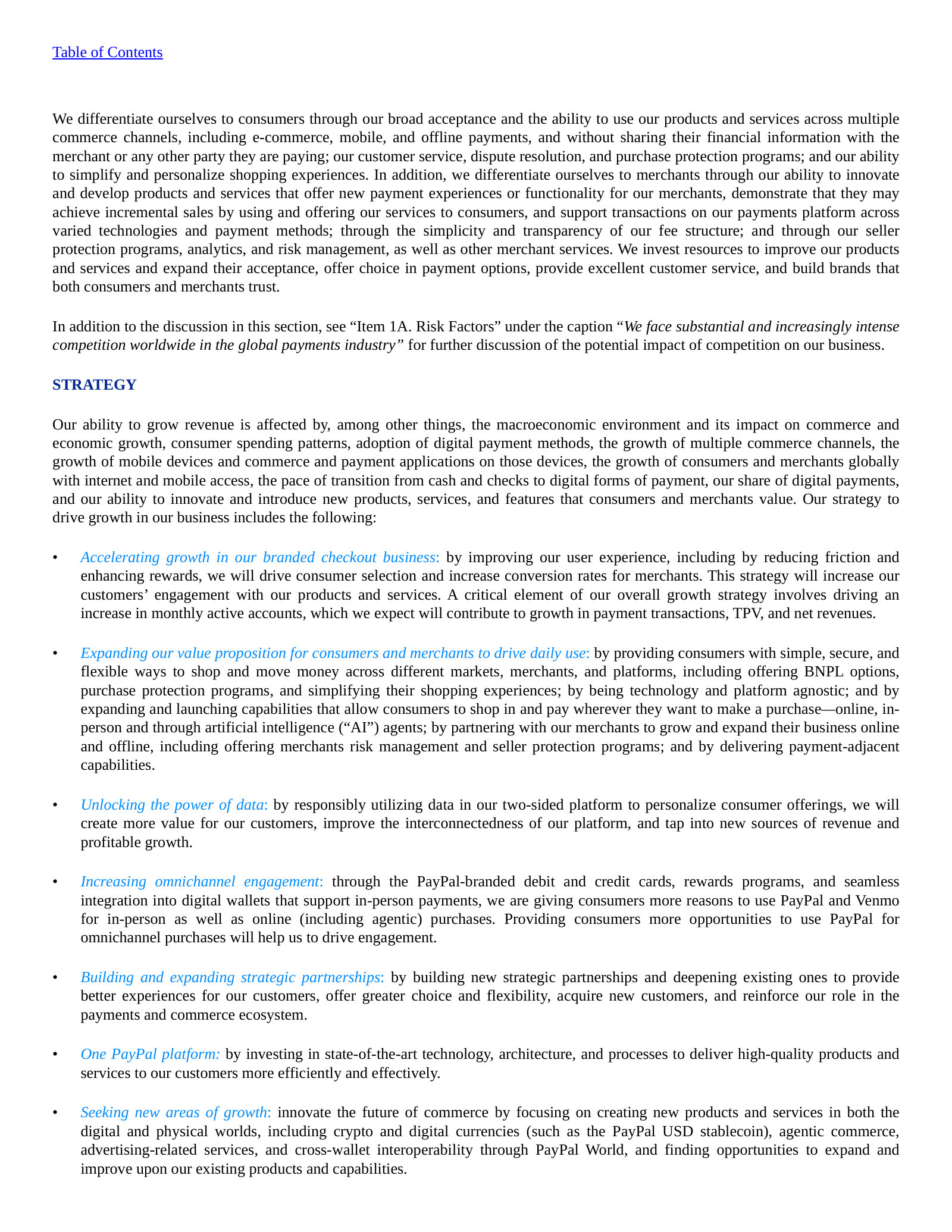
Management's seven growth pillars in its own words — from accelerating branded checkout to agentic commerce and the PayPal USD stablecoin.
Item 1A. Risk Factors — Business and Operations Risks — p. 36 · Read the full section →
The two forces that move PayPal's transaction margin most directly — network fee changes and shifts in how consumers fund payments.
Card-network and bank fee changes — a cost line PayPal does not control.
From time to time, the networks have increased the fees and assessments that they charge for transactions that access their networks. Certain networks have also imposed special fees or assessments for transactions that are executed through digital wallets such as those PayPal offers. […] Any increase in interchange fees, special fees, or assessments for transactions that we pay to networks or payment processors could make our pricing less competitive, increase our operating costs, and reduce our operating income, which could materially harm our business, financial condition, and results of operations.
p. 36 · Read in context →
Item 7. MD&A — Overview of Results of Operations — p. 59 · Read the full section →
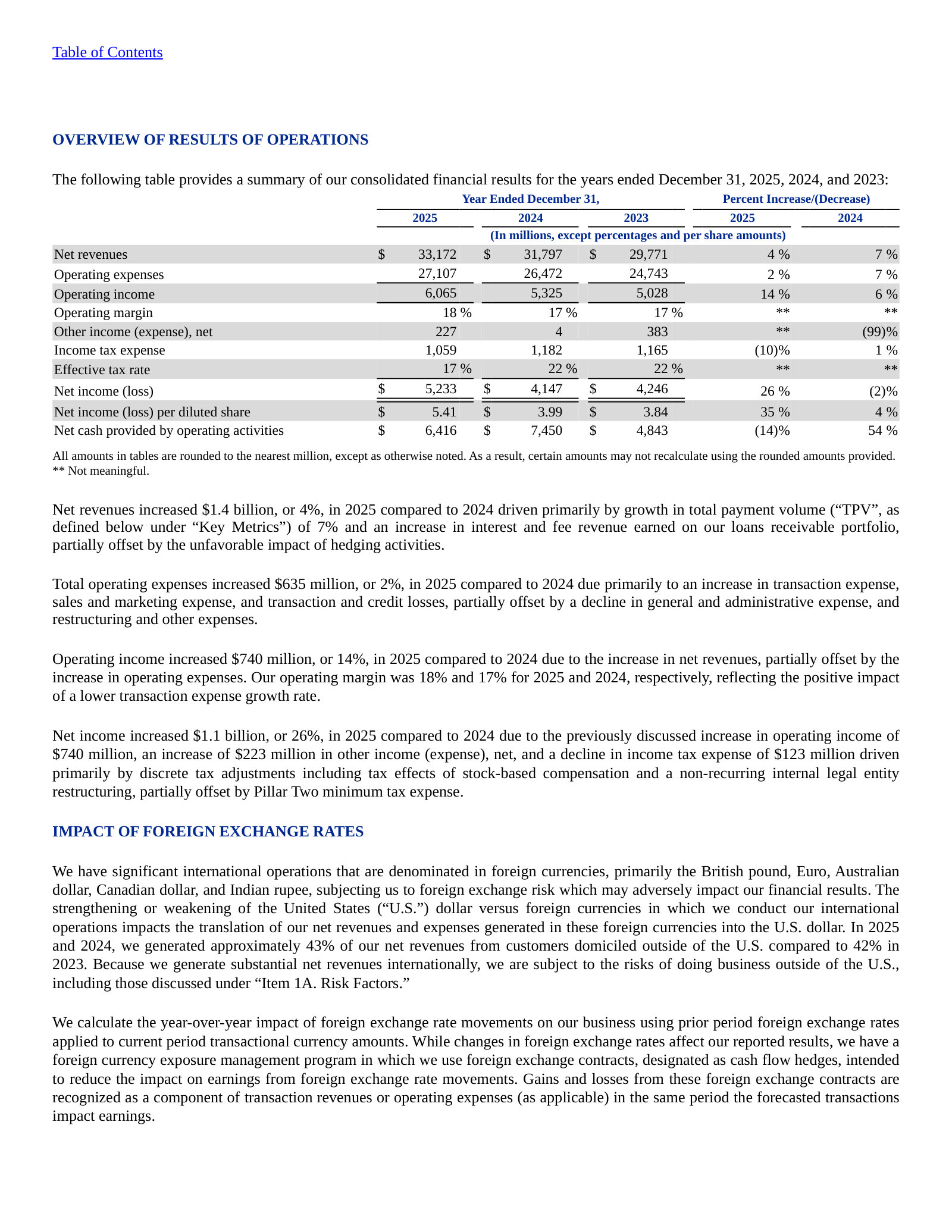
The full year on one page: net revenue +4%, operating margin up to 18%, and net income +26% to $5.41 diluted EPS.
Item 7. MD&A — Net Revenues — p. 63 · Read the full section →
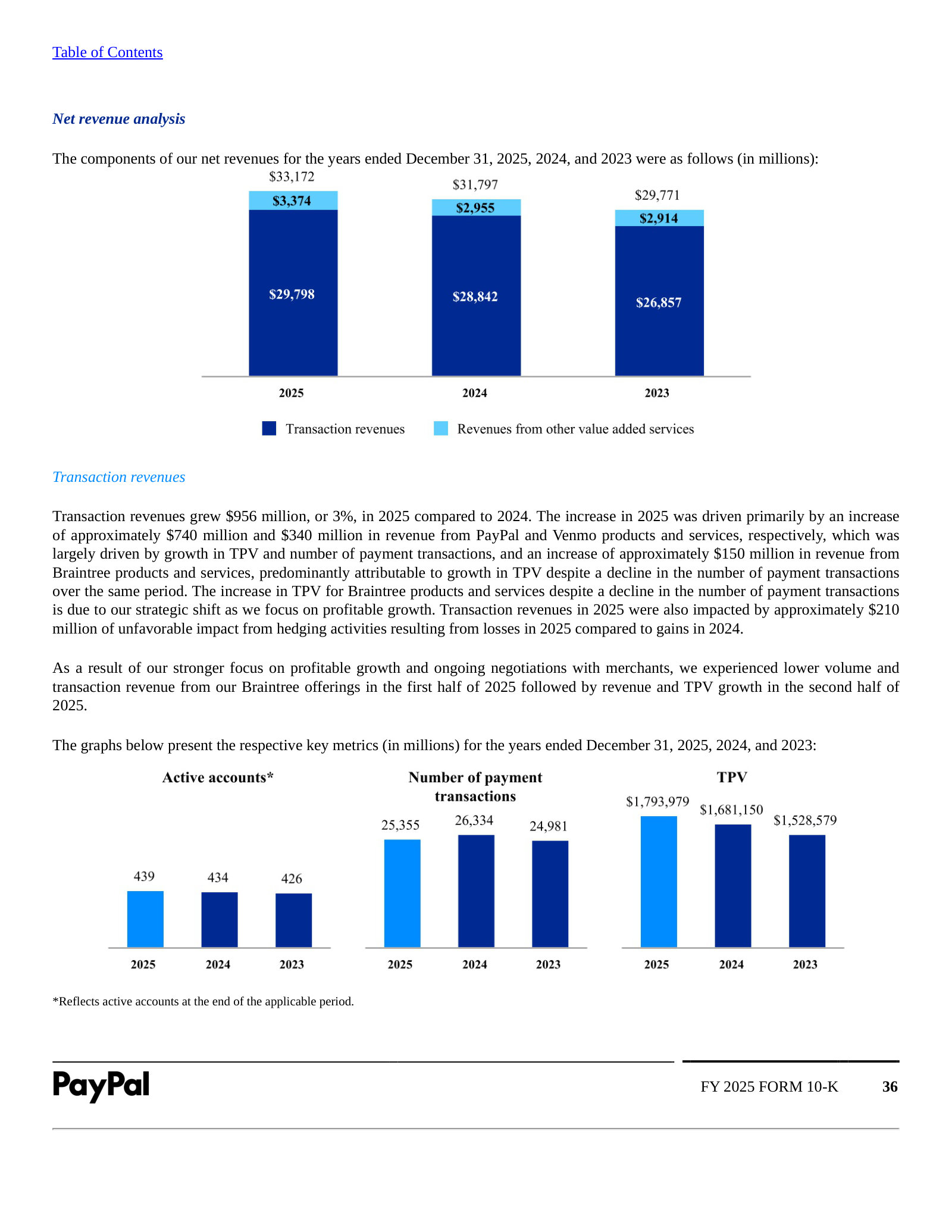
The heart of the FY2025 story: TPV grew 7% while payment transactions fell 4%, because management deliberately shed low-margin Braintree volume.
The profitable-growth pivot stated plainly — volume down on purpose, then recovering.
The increase in TPV for Braintree products and services despite a decline in the number of payment transactions is due to our strategic shift as we focus on profitable growth. […] As a result of our stronger focus on profitable growth and ongoing negotiations with merchants, we experienced lower volume and transaction revenue from our Braintree offerings in the first half of 2025 followed by revenue and TPV growth in the second half of 2025.
p. 64 · Read in context →
Item 7. MD&A — Operating Expenses: Transaction Expense — p. 66 · Read the full section →
Where the margin gain actually came from — funding mix and a lower Braintree weighting cut the transaction expense rate to 0.89%.
Funding-source economics and why the FY2025 mix lowered the expense rate.
The cost of funding a transaction with a credit or debit card is generally higher than the cost of funding a transaction from a bank or through internal sources such as a PayPal or Venmo account balance or our consumer credit products. […] The decrease in transaction expense rate in 2025 compared to 2024 was primarily attributable to a lower proportion of TPV from Braintree products and services, which generally have higher expense rates than other products and services, and changes in merchant mix.
p. 66 · Read in context →
PayPal Holdings, Inc. — FY2021 Annual Report (Form 10-K) — FY2021 (year ended Dec 31, 2021)
The pre-reset peak, kept for contrast: a COVID-era scorecard that framed the company around raw account and volume growth — the mindset FY2025 walked away from. · Open the full document →
Item 1. Business — Overview — p. 5 · Read the full section →
The older mission language — 'democratizing financial services' and ESG framing — reads very differently from FY2025's blunt focus on profitable growth.
FY2021's mission framing, centered on financial inclusion rather than margin.
PayPal Holdings, Inc. was incorporated in Delaware in January 2015 and is a leading technology platform that enables digital payments and simplifies commerce experiences on behalf of merchants and consumers worldwide. PayPal is committed to democratizing financial services to help improve the financial health of individuals and to increase economic opportunity for entrepreneurs and businesses of all sizes around the world.
p. 5 · Read in context →
Item 1. Business — Key Performance Metrics — p. 8 · Read the full section →
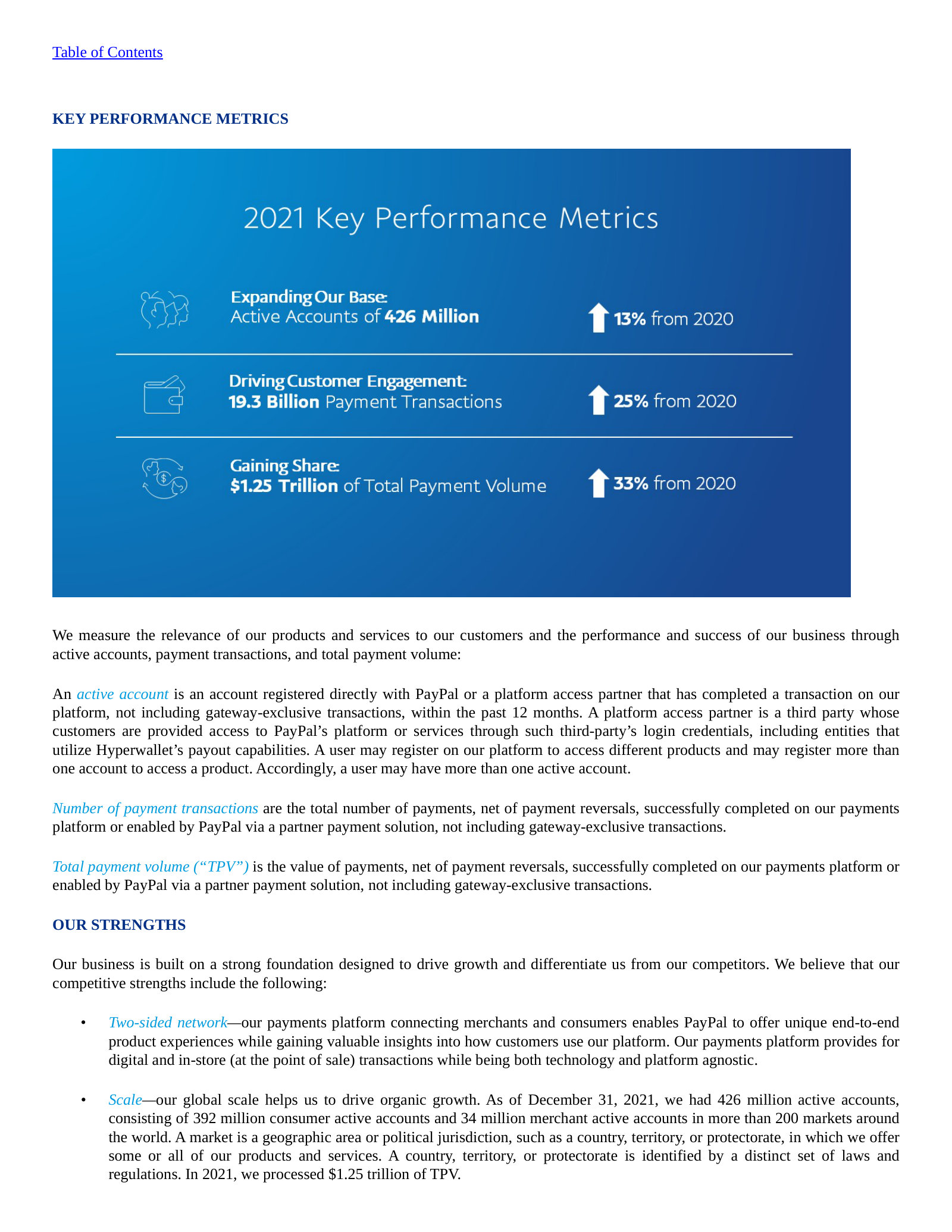
The growth-at-all-costs scorecard — '+33% TPV, +25% transactions' — that makes FY2025's deliberate 4% transaction decline so striking.
More annual reports
PayPal Holdings, Inc. — FY2024 Annual Report (Form 10-K) — FY2024 (year ended Dec 31, 2024) · 177 pages · First full year under CEO Alex Chriss — the transition year where the profitable-growth strategy took hold. · Open →
PayPal Holdings, Inc. — FY2023 Annual Report (Form 10-K) — FY2023 (year ended Dec 31, 2023) · 183 pages · The leadership-change year, capturing the business just before the strategy reset. · Open →
PayPal Holdings, Inc. — FY2022 Annual Report (Form 10-K) — FY2022 (year ended Dec 31, 2022) · 191 pages · The post-COVID hangover year — decelerating growth that set up the eventual pivot. · Open →